
Suppose you’re quietly enjoying your new home one morning, when you’re disturbed by a crowd of strangers in hiking gear, passing through your property. You confront them and discover that they have been using the path by your house for years in order to access a public hiking trail. Can you stop them? Possibly. But private property owners should be aware that in some instances, access can be allowed through private property so the public can reach sites such as state parks or campgrounds. Failure to allow access can subject landowners to lawsuits and legal liability.
One example occurred when the Alaska Supreme Court ruled in 2005 that a non-profit group could proceed with a lawsuit to establish an easement over a couple’s property to gain access to a public hiking trail. (Interior Trails Preservation Coalition v. Gregg and Donna Swope, No. S-11323, 6/24/05).
Facts of the Case
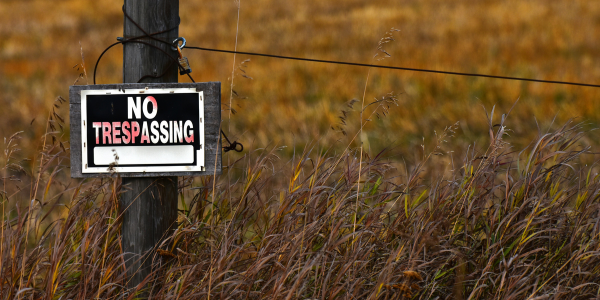
Gregg and Donna Swope purchased land near the Skyline Ridge Trail in Fairbanks in 1997. They bought it not knowing that for more than 40 years, hikers used a path through the property to access the trail. After observing some hikers cutting through the parcel, the couple posted “No Trespassing” signs on the land, according to court records. Some hikers ignored the signs, however, and continued using the path.
In 2002, the Interior Trails Preservation Coalition filed suit seeking to establish a public right-of-way through the Swopes’ property. The group asked a judge to declare a public easement through the parcel since hikers had used it to gain access to the trail since the 1950s.
Efforts to secure such easements are similar to the attempts to establish a legal claim to land under the doctrine of adverse possession. Under this doctrine, claimants must show that they possessed the land for a certain time period without the landowner’s objection. In the case of a public easement, a claimant must show the public used the land for a set time period without objections.
The time period needed to possess or use land to establish these type of claims are different under each state’s law. Alaska requires public use of land for 10 years in order for an easement claim to be filed. The coalition argued that since the public had been using the path to access the trail since at least 1955, the easement claim was established by 1965.
A state court judge threw out the non-profit group’s suit, however, finding that the organization hadn’t been in existence for 10 years, so it couldn’t show that it or its members had used the path for the time required to make a valid public easement claim.
A Higher Court Steps In
However, the Alaska Supreme Court reversed the lower court ruling and reinstated the suit. The justices said the trial judge erred in focusing simply on whether the coalition used the trail, rather than the general public.
To have a valid claim for a public easement, “the coalition was required to prove continuous use by the public in general and not by the organization or any of its individual members,” the Supreme Court ruling stated. The coalition had sufficient evidence of public use to be able to press forward with its suit, the justices added.
The Alaska Supreme Court noted that other states have recognized the validity of public easements over private property. In New Hampshire, for example, the courts ruled in one case the that the general public’s use of a church’s property to access a public beach for 20 years was enough to establish a public easement claim. (Elmer v. Rodgers, 214 A.2d 750, 1965).
The Swope case should serve as a red flag that there are some situations in which there is little private property owners can do to bar public use of their land. Posting “No Trespassing” signs on the parcel won’t block public easement claims that have already been established through historical use of the property. Consult with an experienced land-use attorney when buying or selling property for an assessment of whether the parcel may be subject to such claims.
Types of Easements
There are three distinct types of easements that can benefit or burden your property use, depending on your point of view.
1. An easement in gross such as a public utility easement. This type of easement affects nearly every property. Since these easements are generally recorded in public records, knowledge of their existence is available to purchasers of the land. In some cases, they are obvious, such as overhead power lines. Occasionally an underground easement (a water or sewer line, for example) goes undisclosed. The possibility is one reason why land purchasers should have title insurance to protect them from possible problems.
2. An easement appurtenant benefits an adjacent parcel, such as a driveway that you share in order to give neighbors access to their property. These easements are generally created by court action and recorded.
3. Prescriptive easements arise when people use property without permission, in spite of the fact that a homeowner has asked them to stop.
A prescriptive easement can be created if the property use is open, well known, hostile, and continuous over a specified number of years, which varies by state. If the above requirements are met, a claimant might be able to bring a title lawsuit against the property owner, as the Interior Trails Coalition did against the Alaska couple in the case described in this article.
© Copyright 2025. All rights reserved.
Brought to you by: Duffy Kruspodin, LLP